|
The mountains of this area began as sediments deposited in
an ancient sea and slowly hardened into thick layers of limestone, mudstone, and
sandstone. About 60 million years ago, tensions building within the earth's crust
could no longer be contained, and the rock layers began to warp, fold, and finally
break. A huge slab of rock moved from the west and began to slide up and over the
softer rock of eastern ranges. Evenutally a 300 mile-long portion of the crust had
been thrust more than 50 miles to the east. Throughout the world similar processes
have created other mountain systems, but few can rival the Lewis Overthrust of Waterton/Glacier. |
|
|
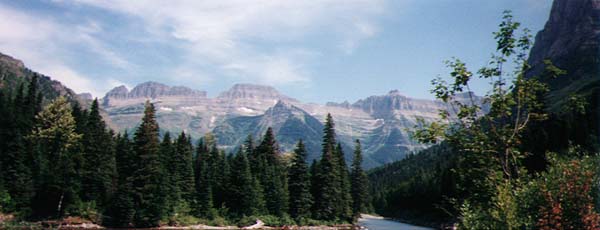
Once the mountains were in place, wind water, and glaciers
went to work on the raw landscape. Glaciers shaped and carved the land, cutting deep
U-shaped valleys. Smaller tributary glaciers created hanging valleys. Today, abundant
waterfalls plunge from these hanging valleys to lower elevations. While glaciers
are no longer found in Waterton Lakes National Park, glaciers are still at work in
the highcountry of Glacier National Park.
Today, this landscape is a wilderness full of wildflowers and
wildlife with distinct local variations. The high mountains that bisect the park
from north to south capture rainfall on the western slopes. This warm, moist, Pacific-like
environment produces dense forests of larch, spruce, fir, and lodgepole pine. In
the Lake-McDonald valley, forests of western red cedar and hemlock are common. The
alpine areas provide the setting for some of the best wildflower displays in North
America. It is a short-lived spectacle, made glorious by heather, gentian, beargrass,
and glacier lily. East of the divide, where the plains roll up to the mounations,
pasque flower, lupine, Indian paintbrush, gaillardia, asters and shooting stars
paint the prairie. |
|