Gear Home Interviews:
Jake Burton
Shaun Palmer
Barrett Christy
Tina Basich
Ross Rebagliati SEE ALSO:
Marketplace
Contests
Auctions
ISF Schedule
FIS Schedule
Ski Resorts



|
Mad Bombers Freecarve Boards for Flying Under the Radar The Boards: [Burton Fusion] [Palmer Channel Titanium] [Sims Daytona] [Salomon FRS] [Nitro ARX] [Völkl Spline]
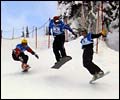
These riders also wear soft boots. They don't mind hiking a bit, dropping a cornice, and getting into the pow. They ride the entire mountain, with an emphasis on smooth. Ski Patrol often shakes a pole at these mad bombers. Resort designate certain runs as "family skiing areas" to keep them at bay. These riders treat the entire mountain as a boardercross course, always looking for the quickest way to get to back to the chair. There's no official term to describe this style of riding-freecarve is the best thing out there-but there are a number of boards on the market this year designed to attack the mountain in an all-out, all terrain turn-fest.
More Snap
Less Shimmy
Maximum Edginess
The Shape of the Future?
Read on for a roundup of the top freecarving boards. Please consult the manufacturers for additional lengths and specifications.
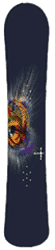
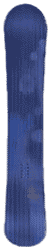
Length: 165 cm Effective Edge: 137 cm Waist Width: 24.5 cm Sidecut Radius: 8.79 M Stance Setback: 2.5 cm Rider Weight: 200+ lbs Retail: $450 Designed by Peter Bauer (Mt. Baker Legendary Banked Slalom fixture, and the P of Burton's JP alpine board, which led the Euro-carve movement in the early 90's) the Fusion is the prototypical freecarve board. Inspired by the Supermodel and notched up for speed, the Fusion can go from corduroy to powder, sheets of ice to crud at high speed and in control (and if you're strapped to if there's a chance you can, too). If you've ever seen Peter ride, you know that's it's all about going fast and staying smooth.
| ||||||
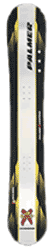
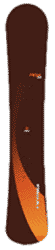
Length: 164 cm Effective Edge: 130 cm Waist Width: 24.6 cm Sidecut Radius: 10.0 M Stance Setback: 2.0 cm Rider Weight: 210+ lbs Retail: $595 Anything designed under the careful eye of Shaun Palmer, the world's most dominant boardercross competitor, is sure to pass the test for going fast in the toughest conditions. The Channel Titaniums grip on ice, have exceptional rebound going edge to edge, and their light weight make them easy to handle in the chop.
| ||||||
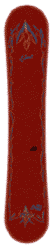
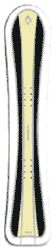
Length: 166 cm Effective Edge: 135.2 Waist Width: 25.6 Sidecut Radius: 9.2 Stance Setback: 2.4 cm Rider Weight: 165+ lbs Retail: $435 The Daytona is for people who own corduroy jackets. It goes fast, lets you hold a solid line on groomers, hardpack, ice, crud, and rutted boardercross course, and will also float you through the hip-deep fresh stuff. Sims has created a flex technology called HPD that blends a stiff nose and medium flex tail to make a super responsive, super stable ride at high speeds.
| ||||||
Length: 165 cm Effective Edge: 133.5 cm Waist Width: 24.1 cm Sidecut Radius: 9.2 M Stance Setback: 2.0 cm Rider Weight: 165+ lbs Retail: $500 The FRS is a performance board for riders who don't stop at every hit to watch their friends. Salomon deploys their HTC-2 Dual flex cross to beef up the torsional rigidity of the tip and tail, and boost a rider's ability to spring rail to rail.
| ||||||
Length: 166 cm Effective Edge:136 cm Waist Width: 23.2cm Sidecut Radius: 9.5/6.5 M Stance Setback: 2.39 cm Rider Weight: 165+ lbs Retail: $415 The ARX is the one board that states it's designed for soft step-in boots. Whatever you ride, you'll feel the snap with the ARX progressive sidecut and carbon core.
| ||||||
Length: 164 cm (also comes in 152, 158) Effective Edge: 135 cm Waist Width: 24.0 cm Sidecut Radius: 8.1 m (3D) Stance Setback: 2.0 cm Rider Weight: 165+ lbs Retail: $450 The Spline isn't an internal organ-it's a freeriding board with a carving heritage. Lightweight, shaped with a progressive 3-D sidecut, and built to pass Völkl's high standards of construction, this board will perform for freeriding equally as well as carving. | ||||||
|
— Jim Humes, Mountain Zone Correspondent | ||||||