The Great Wall Marathon
The Most Magnificent 26.2 Miler of Them All
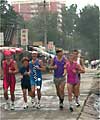
Marathoners addicted to chasing adventure and the adrenaline rush from a runner's high arrived in Beijing this week for the Great Wall Marathon. Yes, believe it or not, there's actually a 26.2-mile race on The Great Wall in China. Fifty athletes, from elite to casual runners, traveled from as far as halfway around the world to compete in the race, drawn by the romance of a racecourse rich in history beneath the soles of their sneakers.
"I've run 52 marathons, including one in Antarctica," said Knox White, of Eldorado, Arkansas. "This course will be beyond compare."
 |
|
|
|
| ...runners training in Beijing, a city of 12 million people, find pollution so thick that sunny days often appear overcast. |
|
|
|
|
The race takes place today, Wednesday, August 30th, entirely atop of the 2,000-year-old fortress, originally built during the Qin Dynasty to keep out looting and pillaging nomads. The Wall's ancient construction includes 4,000 miles of brick steps which are hard to detect from looking at the beautiful landscape photographs of the man-made wonder snaking up and down mountainsides of China. Runners completing the race will climb up and down an estimated 60,000 stairs unevenly worn by time.
"The steps completely exhausted me," recalls Richard Gross, 33, of Italy, who won the race last year in 2:50:31. "My backside was horribly sore from climbing too fast, too early in the race."
Gross, a promising winner for a second straight year, intensified his race training by spending weekends scaling the 7,000-foot mountains in the backyard of his northern Italian hometown, Sarentino, about 100 miles north of Verona. Gross is one of three Italians who will be running. The largest contingent hails from Germany with 23 people, Austria has nine entries and the US is third with eight competitors.
Steps aren't the only challenge that athletes face. There're up to 13 hours of jet lag to overcome and runners training in Beijing, a city of 12 million people, find pollution so thick that sunny days often appear overcast. Even the best athletes experience difficulty breathing during a short run outside. Weather is also a negative factor with temperatures expected to reach 90 degrees on an exposed course offering no relief from the sun. Such adverse conditions give new meaning to "hitting the wall" in this marathon.
|
|
|
|
|
"When I saw a runner down on the Wall getting an IV I decided to drop out of the race by mile 13." |
"Heat and a leg cramp crumbled me emotionally," said Bob Platt, of Cincinnati, Ohio, about his performance in 1999. "When I saw a runner down on the Wall getting an IV (intravenous) I decided to drop out of the race by mile 13."
The Great Wall Marathon, in its fifth year, is the brainchild of Wichard Holscher, an architect from Munich. His sideline business, the Studiosus Gruppenreisen travel agency, solely revolves around organizing three adventure marathons a year, including one located in a desert.
"I saw a slide show of The Great Wall and thought, 'why not a marathon?'" said Holscher, a runner himself and three-time competitor in the Hawaii Ironman.
Holscher contended with plenty of red tape organizing a marathon in China, a country heavily regulated by the communist government. "I must have faxed more than 300 letters to the ministries of Sport, Culture and Security," said Holscher. "It took over a year to organize the first race."
The government limits the race to 80 competitors, a number that's reached when runners from a 10k and half-marathon are included in the tally. The Great Wall Marathon is held approximately 100 miles northeast of Beijing, requiring the runners, from Europe, the US and China, to board a two-hour bus ride just to reach the starting line.
The long bus ride and the challenge of 60,000 steps, 90-degree heat and an unnerving defeat didn't intimidate Platt from his quest this year — to return and cross the finish line. "I dropped 15 pounds and trained on more steps," said Platt who feels better prepared.
Gross, last year's winner, also returned, but not for the love of the Wall. It was for a different, albeit romantic, reason. "I met my Chinese girlfriend at a water stop last year during the marathon," said Gross. "I didn't have time to thank her for the water so I blew kisses and she laughed. On the second lap I was ahead so I stopped to peck her on the cheek."
Gross spent more time with the woman, Christina Xu, after the race but eventually had to head back to Italy. "I gave her my trophy and took home the medal," he said. The two kept in touch by email, a convenient mode of communication for Xu who works in the business center at the Sino-Suiss Hotel where the athletes are staying. She'll be manning a water stop at the race again this year.
While in Beijing, most competitors start the day with a run, passing by public parks filled with elderly locals who rise at dawn to exercise themselves. Seniors practice Yangge, a traditional folk dance, in orderly lines, moving in synchronized harmony to soothing instrumental music emanating from a big, black boom box.
Sightseeing tours are entertaining athletes in the five-days preceding the race. Luckily, marathoners are well-trained for exploring the expanses of Tiananmen Square and the Forbidden City which involve walking for hours. The city streets are decorated with numerous signs of two Chinese children skipping along holding out flags and hopes that Beijing will win the summer Olympics bid for 2008.
Runners are continually amazed at how inexpensive goods and services are in this third world country. A half-hour taxi ride from downtown Beijing to their hotel by the airport costs a mere $4 dollars. Multiple course dinners such as chicken with cashews, barbecued ribs and fried rice can be had for under $2 with a liter of beer included.
Although beer is popular, so is H20 on these hot summer days where the air conditioning frequently breaks down on the tour buses. Runners take care to consume only bottled water, sold here for a mere 15 cents a liter, because tap water is unfit to drink or use for brushing teeth. Only bottled water will be served at marathon water stops on the Great Wall, although it's reportedly warm from sitting for hours in the sun. Runners need only climb a couple of thousand steps each time they want to quench their thirst.
— Kimi Puntillo, MountainZone.com Correspondent
WANT MORE: Mt. Everest Marathon
|