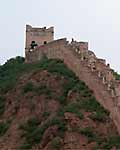
Forty-five athletes from all over the world took their mark on top of 1,000 years of history to run the 5th Great Wall Marathon in China Aug. 31. At 9am sharp, the countdown sounded and runners took off, climbing what was to become an endless series of steps before reaching the finish. The Great Wall, a stone architectural fortress originally built to keep warring nomads out of the kingdom, quickly proved to be a great maze of staircases, twists and turnarounds.
"I almost got lost in a guard tower," said Riccardo Gross of Sarentino, Italy, the winner in 2:35:08. A Chinese race official with a red flag signaled him through a doorway, but from Gross's side it resembled a windowsill. "The staircase was hidden on the other side so it looked like I was going to run off the Wall."
Gross had no trouble staying on course and set a record finish, winning this unique race for the second year in a row while improving his time by more than five minutes.
Marathoners felt more like marines tackling an obstacle course than runners mastering a racecourse, hoisting themselves up 12 foot walls, steadying their foothold on crumbling stairways and climbing step, after step, after step. The 4-lap route ensured that you could repeat the experience again, several times.
With 60,000 stairs embodying the racecourse, every stairway imaginable could be found. There were open-air steps without sides that looked like a flight down from heaven. Short steps with wide terraces scattered about could be climbed two at a time, if you had the stamina. Two-foot high risers hidden in passageways had to be scaled with added effort from triceps and biceps, and hands and arms. There were no flats to be found, in fact, three strides couldn't be made without constantly lifting your feet up or down.
Having run adventure marathons on every continent in the world, I enthusiastically took part in the fun. The concentration involved in each footstep to steady myself on slippery gravel, loose stones ledges, or a single brick narrower than my sneaker took so much focus that I lost track of time, a liberating feeling I loved. This marathon was not all about running, it demanded much more, my whole body and mind were challenged.
This section of the Wall, built during the Ming Dynasty had not been maintained since then, and it showed. Majestic guard towers crumbled around us, challenging runners to find toeholds that would not drop them off a stairway or ledge. Still, the beauty of the rolling countryside provided a bucolic backdrop so breathtaking that I saw a runner stop in the middle of the race, lean out over the Wall, and just take in the view.
Runners squeezed past the occasional French or German speaking tour group or locals manning souvenir tables stocked with wood Buddhas and Great Wall postcards. Some merchants tried to sell runners trinkets each time we ran by, others also tried to support the athletes.
"So much incentive came for the locals," said Elke Peischl, of Germany, who came in first place for the women in 3:04:30. "A woman in a pink dress would cheer each time I passed, and pointed out the right ledges to climb on the racecourse."
Peischl runs, bikes and swims which helped her overcome a serious head injury she suffered as a World Champion in aerobic rock n' roll dancing. "The cross training helped me win my first marathon race," said Peischl, 42-years old. "Sports is my life now, so I'm happy I won."
Crossing the finish line in 3:51:42 was Jim Bates, 42, an U.S. Army Officer from Hopewell, Virginia. The physical demands of climbing and crawling the course added more time to his race than he expected. "I came in an hour worse than my average," said Bates, who was still the first of 6 Americans to finish.
The Great Wall Marathon was inspired by Wichard Hölscher, an architect from Munich, who himself is a Hawaii Ironman triathlete and runner. Holscher's sideline business, the Studiosus Gruppenreisen travel agency, organizes three adventure marathons annually, including one in the Arabian Desert.
After spending a year cutting through red tape to get permission from the Chinese government to organize the event, Hölscher was determined to find the right spot for the race. He ran more than 100 kilometers on the Great Wall to find a course worthy of its namesake. After settling on a section of the wall 100 miles northeast of Beijing in nearby Jin Shan Lin, the racecourse still had to be measured, so he used a 30-meter string. A 4-lap race of 42 kilometers amounted to stringing out 350 lengths on this simple measuring device.
"I recorded each string length on paper so I wouldn't lose count," said Hölscher of the long day he had measuring the wall.
Control points occupied each end of the three-pronged course with large red and yellow U-Turn signs in case anyone forgot to head back. Water, Coke and an over diluted electrolyte drink could be had at check points on this overcast day that brought down temperatures to the low 80's, but left the humidity at a steaming 95%. No portable toilets or other facilities were available. Runners were asked to climb off the wall if the need should arise although few adopted this option.
Marathoners from Germany, Austria, Switzerland, the U.S. and Italy boarded a two-hour bus ride to the start and had to head back on the same long trip after the finish. No matter what time you finished, no one could go home a take a hot shower until everyone ended the race.
No one seemed to mind hanging out a little longer with history. As each runner finished, they sat on the Wall, snacking on lunches and haggling with locals for Great Wall T-shirts and other souvenirs. A pair of masseuses with portable tables rubbed down muscles as remaining competitors whizzed back and forth to finish the course.
The crowd followed the last runner Bob Platt, 42, of Cincinnati, Ohio who could be seen several miles in the distance winding his way up and down stairs toward the finish. He traveled to China just for the race, forced to drop out last year from leg cramps and physical exhaustion. Just over 6� hours after the race start he leaped up to the finish, surrounded by cheers for his effort.
At an awards ceremony, athletes received trophies and red silk portfolios displaying certificates with official times recorded from an alarm clock. Runners shouldering backpacks straggled back toward the buses engulfed by villagers eager to sell them everything from blankets with panda designs and beer. As we headed for the long journey home, I was saddened that such a magnificent day had ended.
The correspondent finished the race in 4:51:25.