
There are neither roads nor trails leading to Alaska's remote Mount St. Elias in the winter, just the 15-mile-long Tyndall Glacier stretching from the Gulf of Alaska to the base of the 18,008-foot peak. Until early this year, St. Elias was the continent's tallest mountain that had never been climbed in winter. Only one previous winter attempt on St. Elias had ever been made. That 1992 expedition ended in a fiasco of lost gear and buried snow caves as storms dropped an incredible 20 feet of snow on the mountain in under three weeks.
So it was some trepidation, not to mention a huge 40-day supply of food, that Joe Reichert, Gardner Heaton and David Briggs stepped from their air taxi onto the foot of the Tyndall glacier on February 13 to attempt the first winter ascent.
"The hardest part of St. Elias is the weather," said Reichert from Cordoba, Alaska where he works as a park ranger. "We expected to be waiting, waiting and waiting -- but we had better weather than we expected the whole time. We only had two storm days on the way up and two weeks of really nice weather."
The team's original goal was to retrace an ocean-to-summit route along the South Ridge that was first climbed in the summer of 1947. Once on the summit they would complete a traverse by descending the other side of St. Elias back to the ocean. But while the team's mid-century predecessors on this route had the benefit of massive air support, receiving supply drops at 10,000, 13,000 and 15,000 feet, Reichert, Heaton and Briggs would have to carry their supplies with them the whole way.
As it turned out, climbing from sea level proved impossible due to massive crevassing in the lower part of the glacier. "The first two miles of the Tyndall Glacier were just incredibly broken up because of the dry year so it just wasn't feasible," said Reichert. Instead, the trio started at 2300 feet and ferried loads to five successive camps. "We didn't want to get too far from our supplies because of the weather so we had everything we owned with us at 10,000 feet," said Reichert.
At that point on the mountain, still several days from the top, motivation differences within the group led to a decision to abandon the traverse down St. Elias's opposite face -- a choice that unburdened the group from a still-massive load of supplies. "We had a heart-to-heart at ten [thousand]," explained Reichert, "and ended up leaving stuff there and coming back down the same way." The decision may well have meant the difference between success and failure. Only fifteen days after setting out, the trio danced a jig on the summit amid howling winds on February 29.
Recalls Reichert, "when we got to the top the view was just incredible. The ocean was under a layer of fog right along the coast but I could see Fairweather several hundred miles away," he said. "We could have seen Hawaii if it was a little taller."
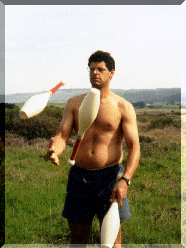 |
About the Author Michael Coffino is a freelance writer based in Berkeley, California. A graduate of the University of Oregon and the University of Wisconsin - Madison, he is currently Senior Editor at The North Face, Inc. His work has appeared in Adventure Times Magazine, Diablo Magazine, Sierra Club Yodeler, Cups and the Wisconsin Law Review. The photo shows the author practicing his juggling in northern California. |
Find out more about Mount St. Elias
The Mountain Zone Bookstore features manuals of technique and guide books for climbing, hiking, and other outdoor activities like bicycling and skiing. You can browse titles, view covers and even examine tables of contents.
Back to the Expeditions Page